Local guide
Stepped cracks in brickwork and what they mean
A staircase crack running through mortar joints is the most common thing people describe when they call about their home. Find out what stepped cracks in brickwork usually point to, what a specialist checks before calling it movement, and who to ask first.
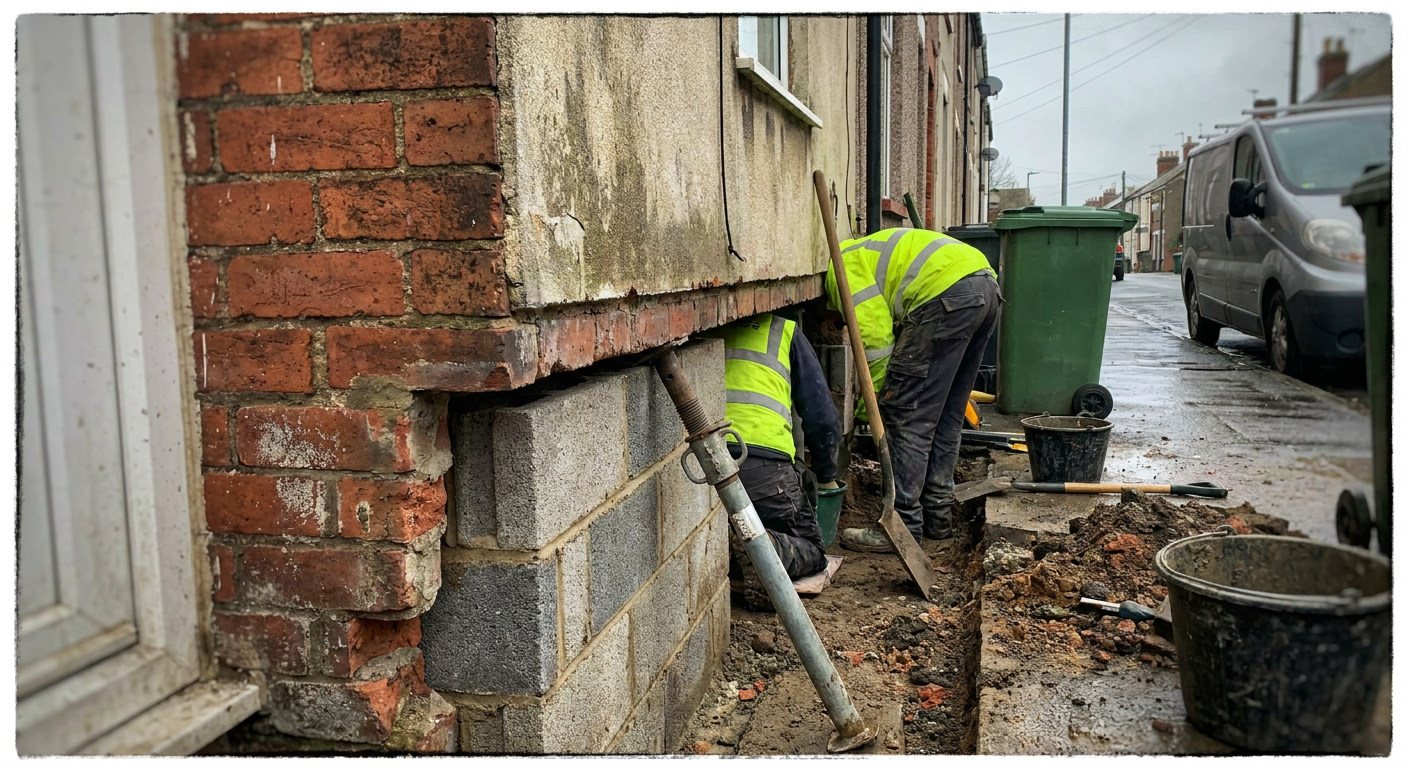
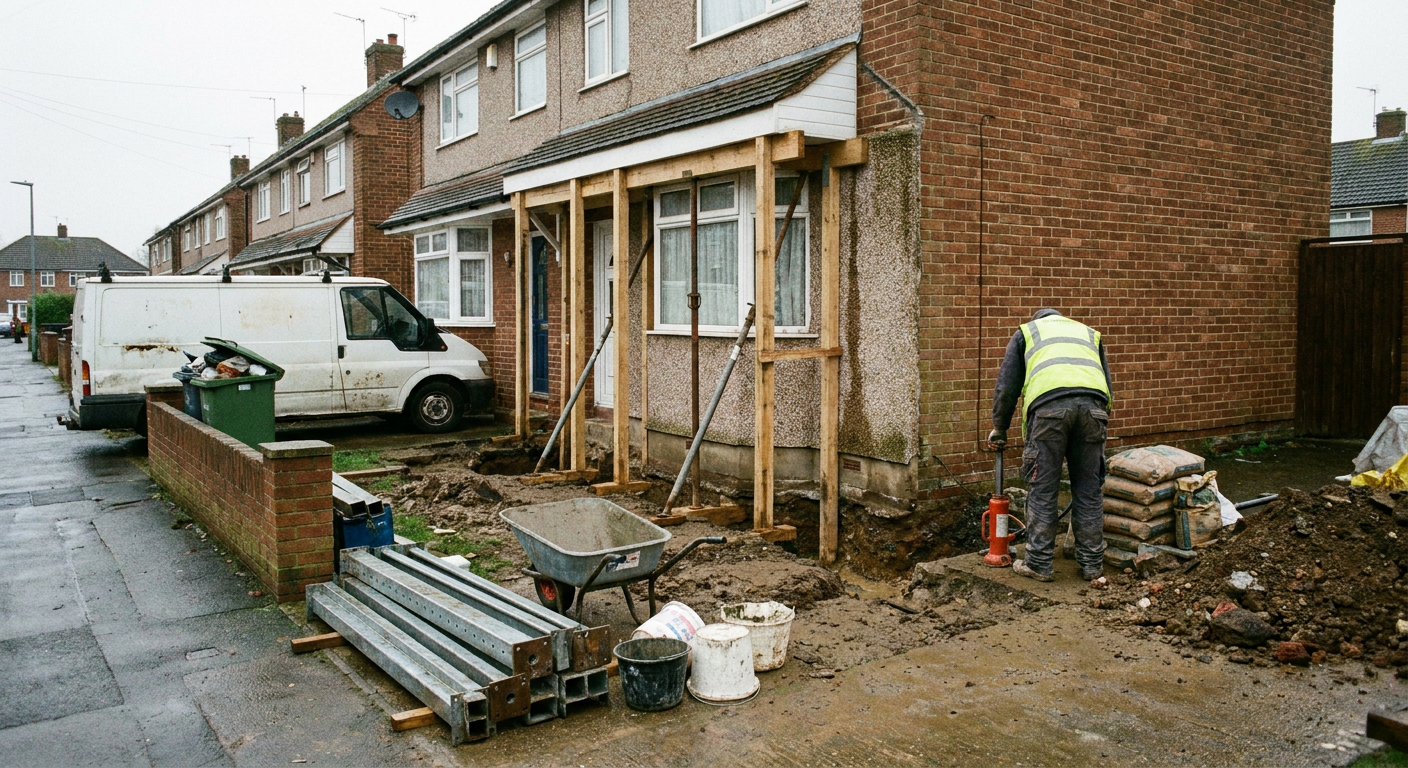
What a staircase crack through mortar joints means
When a diagonal crack follows the mortar lines rather than splitting the bricks themselves, it forms a staircase pattern. This happens because the mortar is softer than the surrounding masonry, so any stress finds the weakest path. A stepped crack in brickwork can point to several things. The ground beneath one part of the house may have shifted, or a lintel above an opening may have failed.
People often notice a crack above window brickwork first, since openings concentrate stress. If you have a stepped crack running through the mortar joints above your window, how worried should I be? That depends on width, speed of growth, and whether doors nearby have started sticking. Hairline mortar cracks are common in older houses across Huddersfield and do not always signal trouble. Wider gaps that keep opening after repair need attention. Read more about [measuring a crack week by week](/what-you-can-see/measuring-a-crack) to see if yours is growing.
Does a stepped crack always mean subsidence?
No. Does a stepped crack always mean subsidence, or can it be something simpler? Thermal expansion, drying plaster, or a settling extension can all produce similar patterns. True subsidence involves the foundation moving because the soil beneath it has changed volume. In Huddersfield, [millstone grit and clay ground](/news/millstone-grit-and-clay-ground-under-huddersfield-homes) reacts to wet and dry seasons, shrinking in summer and swelling in winter. That seasonal cycle opens and closes cracks repeatedly.
Distinguishing a subsidence crack or settlement from harmless shrinkage takes measurement over time. A specialist will look for a consistent direction of movement, usually pointing toward the area where the ground has dropped. They also check for [old mine workings](/what-you-can-see/old-coal-and-quarry-workings) under the street, which affect parts of the town differently. If the crack appeared suddenly after a long dry spell, [clay shrinkage](/what-you-can-see/cracks-after-a-dry-spell) is a likely cause. If it followed heavy rain near a drain, water washing soil away is another.
Width and location: when to worry about wall cracks
What width of stepped crack is a specialist going to take seriously? Cracks wider than five millimetres generally warrant investigation. Anything narrower might still matter if it crosses several courses of brick and keeps widening each month. Location matters as much as size. Why do stepped cracks seem to appear at the corner of the house and near extensions? Corners sit where two walls meet, so differential movement shows there first. Extensions often have shallower foundations than the original building, making them prone to separate movement.
If you notice [doors and windows out of square](/what-you-can-see/doors-and-windows-out-of-square) alongside the cracking, the frame has distorted with the wall. An [upstairs floor sloping](/what-you-can-see/sloping-floors) toward the affected side adds weight to the concern. These signs together suggest the structure is shifting, not just the surface finish cracking.
Who inspects cracked walls in Huddersfield first?
Who do I call first in Huddersfield, a builder, a structural engineer or an underpinning specialist? A general builder can repoint mortar, but repointing a moving crack simply hides the evidence. Is it worth repointing the crack now or will that hide what is happening? Fresh mortar masks the problem and makes later assessment harder. Leave the joint open until a chartered structural engineer or a specialist subsidence surveyor records its shape and width.
A [subsidence survey](/subsidence-survey-huddersfield) is the usual starting point. The surveyor visits, maps every crack, checks drainage, and looks at the soil. From villages like [Meltham](/round-huddersfield/meltham) and [Honley](/round-huddersfield/honley) to central streets, the geology varies, so local knowledge matters. If the survey points to foundation failure, the next step might involve [mass concrete underpinning](/mass-concrete-underpinning-huddersfield) or [mini piled underpinning](/mini-piled-underpinning-huddersfield) where access is tight. For homes with lower levels, [basement underpinning](/basement-underpinning-huddersfield) addresses the deeper footings.
Insurance, monitoring, and repair options
Should I report this to my insurer before I have anyone look at it? Many policies require prompt notification of suspected subsidence, but calling without evidence can start a claims process you cannot pause. It helps to understand [whether buildings insurance covers subsidence](/what-you-can-see/subsidence-and-your-policy) before dialling. Having a survey done first gives you facts to present, rather than a vague worry.
What will a specialist actually check when they visit, and does it cost anything to find out? They examine the whole exterior, measure crack widths, check for leaking drains, and assess tree proximity. Enquiries about initial assessments can be made through the [contact page](/contact). If movement needs tracking, [structural monitoring](/structural-monitoring-huddersfield) uses gauges fixed across the crack to record changes over months. Once the cause is stable, [crack repair](/crack-repair-huddersfield) restores the wall. Where the ground itself needs strengthening, [resin injection](/resin-injection-huddersfield) compacts loose soil without excavation. Understanding [who pays for underpinning](/who-pays/about) early prevents surprises later.
Reading the signs on your walls
The same crack pattern can come from different causes. Where it sits, how wide it opens, and what else has moved nearby all change what it points to.
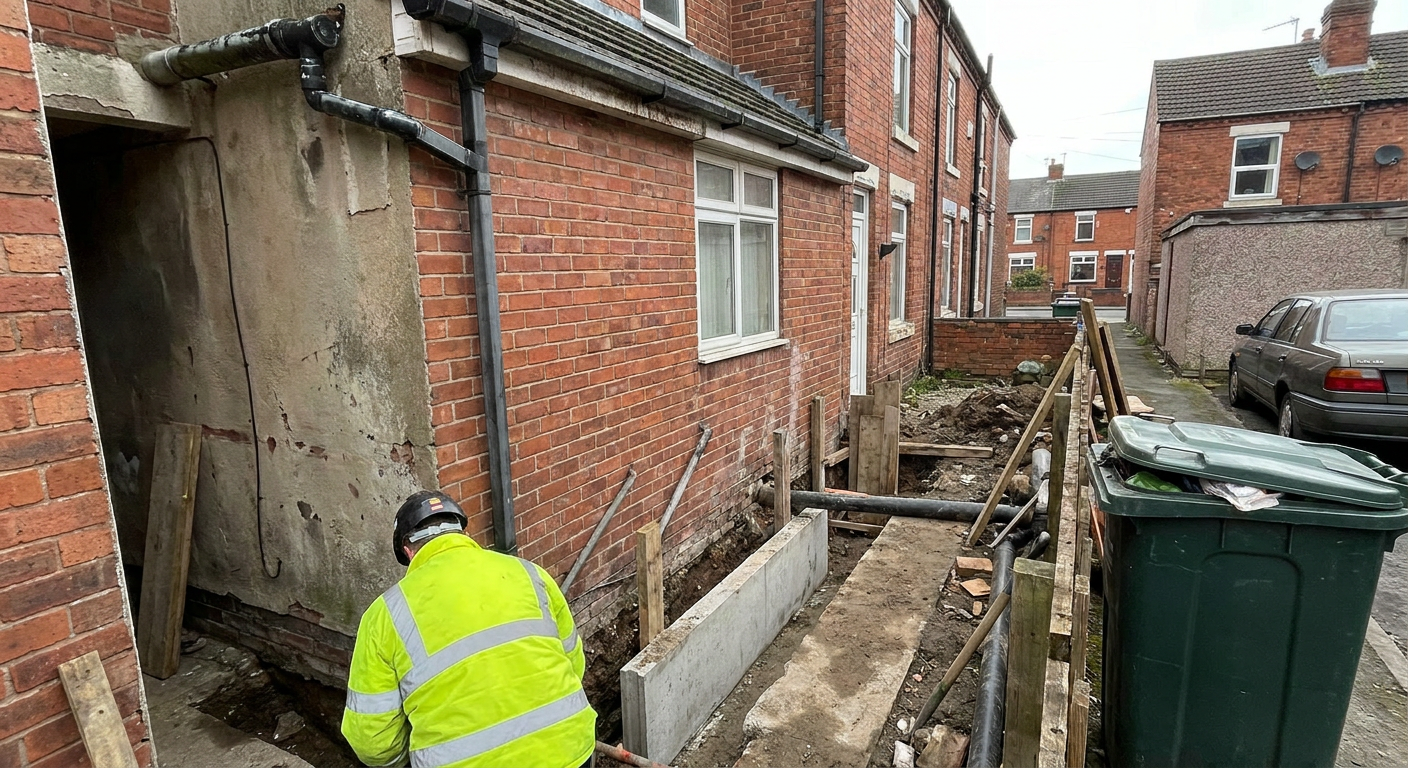
- Crack stepping up from window corner
- Stepped cracks in brickwork above a window often point to lintel deflection or local settlement rather than deep foundation failure. A structural survey confirms whether the ground below is affected and what repair is needed.
- Diagonal line across a gable end wall
- A diagonal crack near the roofline usually suggests thermal movement or roof spread pushing the wall outward. Checking the wall ties, timber structure and mortar condition settles whether the cause is active or historical.
- Gap opening between house and extension
- Cracking at corners or where an extension meets the main house typically points to differential settlement between two foundations of different ages or depths. Monitoring over a full season shows if that movement continues.
- Mortar dust falling from a stair crack
- A staircase crack running through mortar joints indicates shear stress where bricks move against each other. Measuring the width week by week determines whether the movement is still active or has stabilised naturally.
Repointing or investigating first
Covering a crack with fresh mortar feels like progress, but it removes the evidence needed to judge the problem.
| Repoint the mortar | Investigate first | |
|---|---|---|
| Visibility of movement | Repoint the mortarHides the crack completely, making future checks harder. | Investigate firstLeaves the joint open so a surveyor can map its exact path. |
| Cost if wrong | Repoint the mortarWasted money if the wall moves again and breaks new mortar. | Investigate firstSpent once on diagnosis, avoiding repeat cosmetic repairs. |
| Insurance position | Repoint the mortarInsurers may question why damage was covered up before reporting. | Investigate firstShows a clear timeline of discovery, survey, and action. |
| Structural clarity | Repoint the mortarCannot tell if the issue is surface deep or foundation level. | Investigate firstEstablishes whether underpinning or simple repair is needed. |
A specialist advises which route suits after examining the specific wall and ground conditions.
Ask about the cracks in your home
Send details of what you have noticed. A specialist firm reviews the description and advises whether a site visit is warranted. There is no obligation to proceed with any work.
- No obligation
- Local specialists
- Plain advice