Services
Subsidence repair services in Huddersfield
Every method used to stabilise a home around Huddersfield is listed here. Each entry explains what the work involves and links to the full detail, so you can find out which approach fits the problem you have noticed.
Finding the cause before any work starts
A crack or a sticking door does not tell you what is happening below ground. The first step is always a subsidence survey, where a specialist firm examines the building, records the damage and establishes whether the movement is ongoing or historical.
That survey determines everything that follows. Without it, nobody can say which repair method suits the ground beneath your home or how deep the work needs to go. Read more about what a [subsidence survey](/subsidence-survey-huddersfield) involves and what the findings mean for your house.
Sometimes the right response is simply to watch. Structural monitoring tracks movement over weeks or months, measuring whether a crack is still widening or has settled on its own. This avoids unnecessary excavation when the ground has already stopped shifting.
Strengthening foundations with concrete and piles
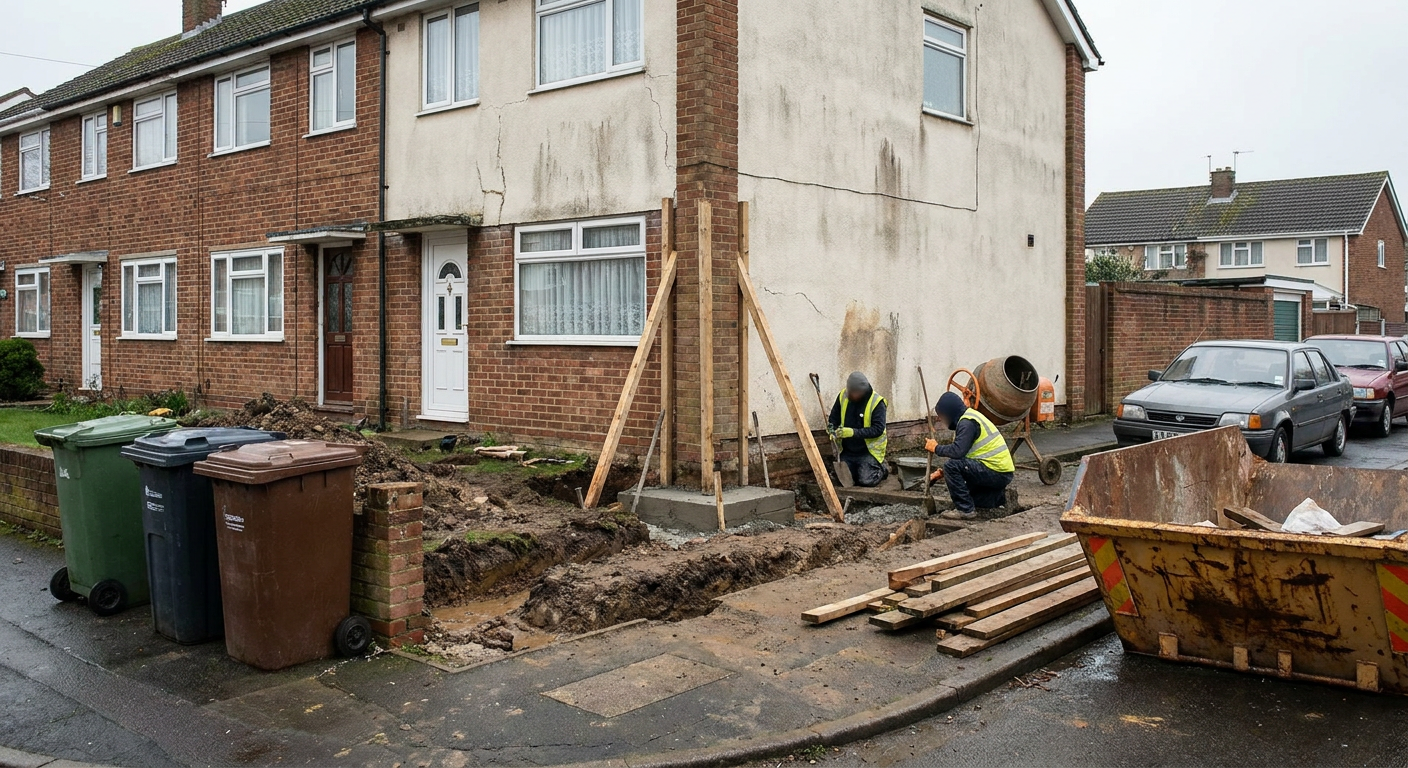
When a home needs its footings supported, mass concrete underpinning is the traditional method. A specialist firm excavates sections of soil beneath the existing foundation in a controlled sequence and pours concrete to form a new, deeper base. This suits many older houses built on shallow footings across the area.
Where access is restricted or the stable ground sits far below the surface, mini piled underpinning reaches deeper. Steel-cased piles are driven or bored through weak soil until they rest on load-bearing strata. This method works well in tight terraces and yards where large machinery cannot fit.
Both approaches require building control approval and careful sequencing so the structure above remains supported throughout. The choice between them depends entirely on what the ground investigation reveals about the soil type and depth to competent bearing layers.
Stabilising the ground without major excavation
Digging beneath a house is not always necessary. Resin injection ground stabilisation uses expanding structural resin pumped into the soil to compact loose ground and fill voids. A specialist firm carries out this work from small drilled holes, causing far less disruption than open trenches.
This method suits situations where the soil has loosened because of water escape or minor settlement rather than deep-seated failure. It can also arrest movement quickly, which matters if cracks are widening week by week.
Foundation repair covers a wider range of problems, including cracked concrete footings, deteriorating brickwork below ground level and floors that have dropped at the edges. The right technique depends on the material the original builders used and how badly it has degraded. Both resin injection and direct foundation repair start with understanding exactly what has failed and why.
Creating space below an existing floor
Basement underpinning serves a different purpose from stabilisation. A specialist firm lowers the floor of an existing cellar to create usable headroom, extending the foundation walls downward in carefully managed stages.
The process combines structural support with excavation. Each section of wall is underpinned before the next is started, so the house above never loses its footing. This work demands precise engineering and constant checking of levels as the dig progresses.
Homeowners usually commission basement underpinning to convert a cramped storage space into a habitable room. Because it alters the depth and loading of the original foundations, the design must account for the water table, the type of soil and the weight of the building above.
Repairing the visible damage to your home
Once the ground is stable and the foundations are secure, the cracks remain. Crack repair addresses the visible damage left behind by movement, from hairline fractures in plaster to stepped cracking running through external brickwork.
A specialist firm cuts out damaged mortar, stitches masonry back together with helical bars and fills gaps with flexible compounds designed to accommodate minor future thermal movement. The aim is to restore strength and weather resistance, then leave a surface ready for redecoration.
Leaving cracks open after underpinning invites damp and allows wind to penetrate cavity walls. Repair work typically happens a few months after the structural phase, once monitoring confirms the building has settled into its new position and no further significant movement is expected.
Underpinning a whole house and choosing who does it
When subsidence affects multiple walls or the entire footprint of a home, [house underpinning](/house-underpinning-huddersfield) becomes the project. A specialist firm plans the sequence so the building remains safe to occupy while work proceeds around and beneath it.
Selecting [underpinning contractors](/underpinning-contractors-huddersfield) requires checking their experience with local ground conditions. The geology around Huddersfield varies considerably, from [millstone grit and clay](/news/millstone-grit-and-clay-ground-under-huddersfield-homes) to [old mine workings](/what-you-can-see/old-coal-and-quarry-workings). A contractor familiar with these conditions will anticipate problems that a general builder might miss.
Ask how they handle [building control applications](/news/building-control-approval-for-underpinning-in-huddersfield), what insurance-backed guarantees they offer and whether they provide [structural monitoring](/structural-monitoring-huddersfield) after completion.
Tell us what you have noticed at home
Send a description of the problem and your address. A specialist firm reviews the details and responds with what to do next. There is no obligation and no fee for this initial enquiry.
- No obligation
- No call-out fee
- Local specialists
Services
- Subsidence Survey
A subsidence survey in Huddersfield checks what is moving and why, from clay shrinkage to leaking drains and old mine workings, and what happens next.
- Mass Concrete
Mass concrete underpinning in Huddersfield deepens shallow foundations bay by bay. Learn what the work involves and which local homes it suits.
- Mini Piled
Mini piled underpinning in Huddersfield reaches firmer ground below weak soil where access is tight. See how the piles work and when this method is used.
- Basement underpinning
Basement underpinning in Huddersfield deepens foundations so a cellar floor can be lowered. Find out what the work involves and who it suits.
- Crack repair
Crack repair in Huddersfield covers stitching, repointing and filling after movement has stopped, plus how to tell cosmetic cracks from structural ones.
- Structural monitoring
Structural monitoring in Huddersfield tracks whether cracks are still moving, using fixed studs or gauges read over months before repair choices.
- Resin Injection
Resin injection ground stabilisation fills weak or washed out ground under foundations in Huddersfield. Find out how it works and when it suits a home.
- Foundation repair
Foundation repair in Huddersfield covers cracked walls, sinking floors and failing footings. Find out what causes movement and which options exist.
- House Underpinning
Underpinning a subsiding house in Huddersfield: what the work involves, how foundations are strengthened and the checks that come before any digging.
- Contractors
Underpinning contractors in Huddersfield: what to look for in a quote, from the survey and method statement to building control sign-off.