Help and advice
Cracks in walls advice for Huddersfield homeowners
Find out what the crack means, when to get foundations checked, and how an enquiry works. This is practical cracks in walls advice for anyone worried about movement in a Huddersfield home.
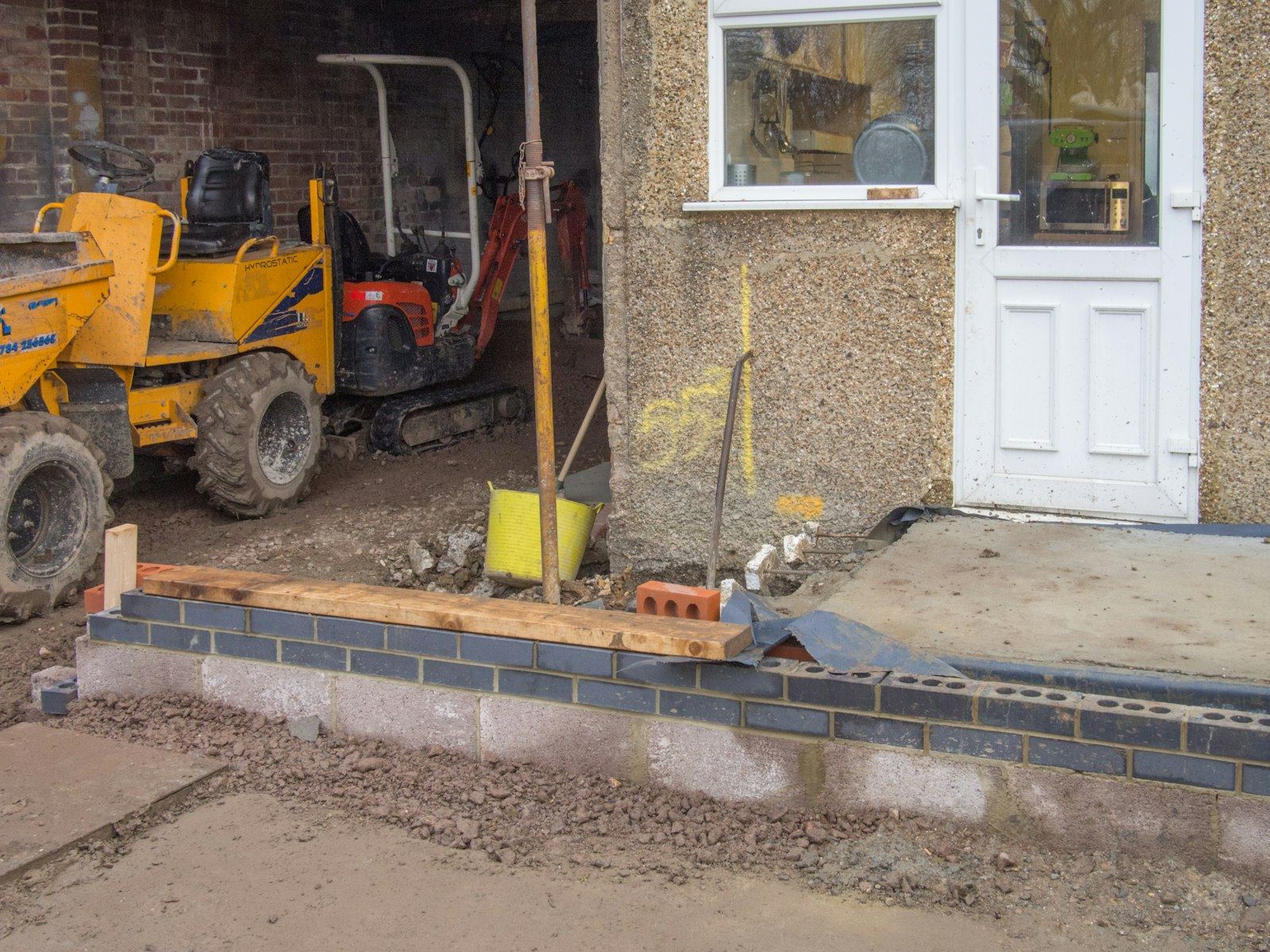
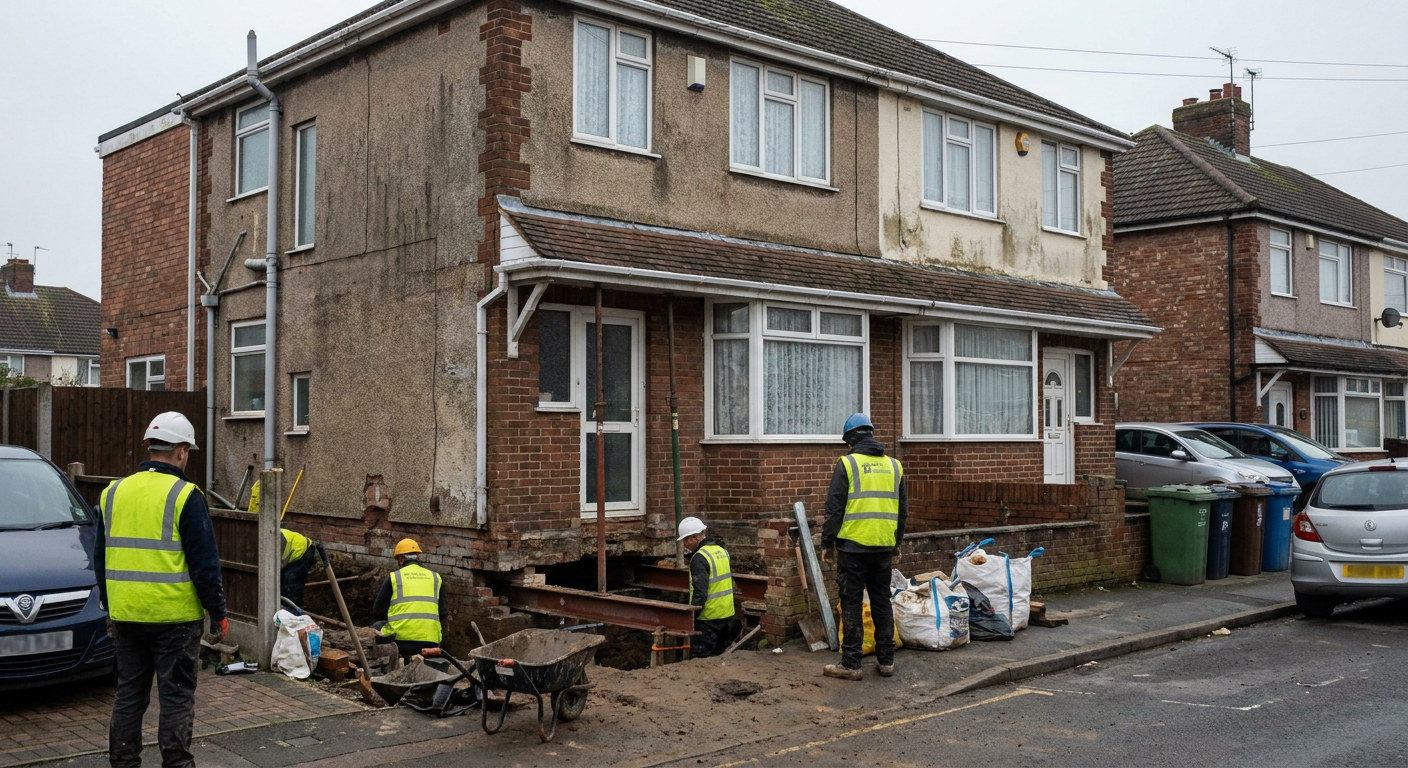
Reading the signs in your brickwork
A hairline crack above a window frame after plastering dries is normal. Stair step cracking brickwork that follows the mortar joints tells a different story. People often wonder if cracks in walls are serious. The answer depends on where they sit, how wide they have opened, and whether they are still moving.
Clay soils around Huddersfield shrink in dry summers and swell when rain returns. That cycle causes seasonal movement. A crack that opens in August and closes by November usually points to this pattern rather than a failing foundation. Read more about [new cracks after dry weather](/what-you-can-see/cracks-after-a-dry-spell) to see how clay shrinkage behaves locally.
If you are trying to work out what to do about a cracked wall, start by looking at the shape. Straight vertical splits often follow thermal expansion. Diagonal lines running from a corner down towards the ground suggest something has shifted beneath the footing. Understanding these patterns helps you decide whether to watch the wall or call someone out.
Settlement, heave and subsidence
New houses settle as the weight of the building compresses the ground below. This happens evenly across the footprint and rarely causes lasting damage. Subsidence is different. It means part of the foundation has dropped because the soil underneath can no longer support the load. Heave pushes the ground upward, usually because a large tree was felled and the clay started absorbing water again.
The settlement or subsidence difference matters because the repair methods are entirely separate. Settlement needs time. Subsidence might need underpinning. A specialist firm will look at the history of the house, the soil type, and nearby drainage before deciding which one is happening. Millstone grit and clay ground under Huddersfield homes behave in specific ways, so local knowledge shapes every decision.
Old mine workings add another layer of uncertainty in some parts of the town. If your home sits above former coal or quarry sites, the ground may have voids that shift without warning. Checking [old mine workings and house cracks](/what-you-can-see/old-coal-and-quarry-workings) explains why this geology demands a different approach to investigation.
Measuring and photographing cracks
You should measure and photograph the cracks before anyone visits. Use a ruler held flat against the wall and take a clear picture with the date visible. Do this every few weeks. A record showing whether the gap is growing, staying still, or closing gives a surveyor far more to work with than a single glance.
Knowing the crack width and when to worry saves unnecessary alarm. Most specialists treat anything under two millimetres as cosmetic. Between two and five millimetres warrants monitoring. Beyond five millimetres, the structural integrity of the wall may be affected and a proper assessment becomes necessary. Learning [how to measure a crack week by week](/what-you-can-see/measuring-a-crack) sets out a simple method that takes a few minutes each time.
Photographs also help if you later need to make an insurance claim. They prove the timeline and show the progression clearly, which avoids arguments about when the damage first appeared.
Trees, drains and the ground near your home
Should you cut back the tree near the wall or leave it until someone has looked? Leave it. Removing or pruning a mature tree changes how much moisture the soil retains. If the roots were holding the clay steady, cutting them away can trigger heave. Wait for a surveyor to assess the root spread and the soil type first.
Leaking drains wash fine particles out of the ground, leaving voids beneath footings. Blocked gutters pour water against the base of the wall day after day. Both problems cause localised sinking that mimics deeper subsidence. A [subsidence survey in Huddersfield](/subsidence-survey-huddersfield) examines drainage runs alongside the foundations to rule these out.
Doors sticking and sloping floors point to foundation movement when they appear together and worsen over time. A single sticking door in winter might just be swollen timber. But if the frame has twisted out of square and the hallway floor dips toward the same wall, the structure has shifted. Check how [door frames go out of square](/what-you-can-see/doors-and-windows-out-of-square) and why [upstairs floors slope](/what-you-can-see/sloping-floors) to understand what these signs mean together.
Insurance and who pays for the work
Is it worth telling your insurer about a crack before you know the cause? Yes, but choose your words carefully. Report it as suspected movement and ask whether your buildings policy covers investigation costs. Some insurers will appoint a loss adjuster immediately, while others prefer to wait until a structural report confirms subsidence. Reading about [buildings insurance and subsidence](/what-you-can-see/subsidence-and-your-policy) clarifies what policies typically cover and where the excess applies.
If the problem turns out to be drainage failure rather than subsidence, the claim route changes entirely. Water company searches and CCTV drain surveys establish responsibility. Understanding [who pays for underpinning](/who-pays/about) prevents surprises later, since the cost falls on different parties depending on the root cause.
When a homebuyer survey flags structural movement, the buyer and seller must agree on next steps before contracts exchange. A [homebuyer survey noting movement](/what-you-can-see/survey-flagged-movement) explains what those comments mean in practice and how lenders react to them.
How an enquiry works and what happens next
An enquiry starts with a description of what you have noticed and where your home sits in Huddersfield. You do not need technical language. Say which wall the crack is on, how long it has been there, and whether doors or windows nearby have started sticking. Mention any trees close to the building or recent dry spells.
Once the details are logged, a specialist survey firm arranges a visit. What does a first visit involve and is there a charge? The surveyor walks through the rooms, checks the exterior walls, looks at the ground levels, and reviews the drainage layout. Some firms charge for this initial inspection; others include it if the work proceeds. Ask when you book.
From there, the process follows a set path. Read [how underpinning works from first survey to finish](/who-pays/how-we-work-huddersfield) to see each stage. Depending on access and soil conditions, the solution might be [mass concrete underpinning](/mass-concrete-underpinning-huddersfield), [mini piled underpinning](/mini-piled-underpinning-huddersfield) for tight spaces, or [resin injection](/resin-injection-huddersfield) to stabilise loose ground. The specialist firm decides which method suits the site after reviewing the survey data.
What the signs in your walls usually mean
The same crack can point to harmless seasonal change or a shifting foundation. Context determines which one applies to your home.
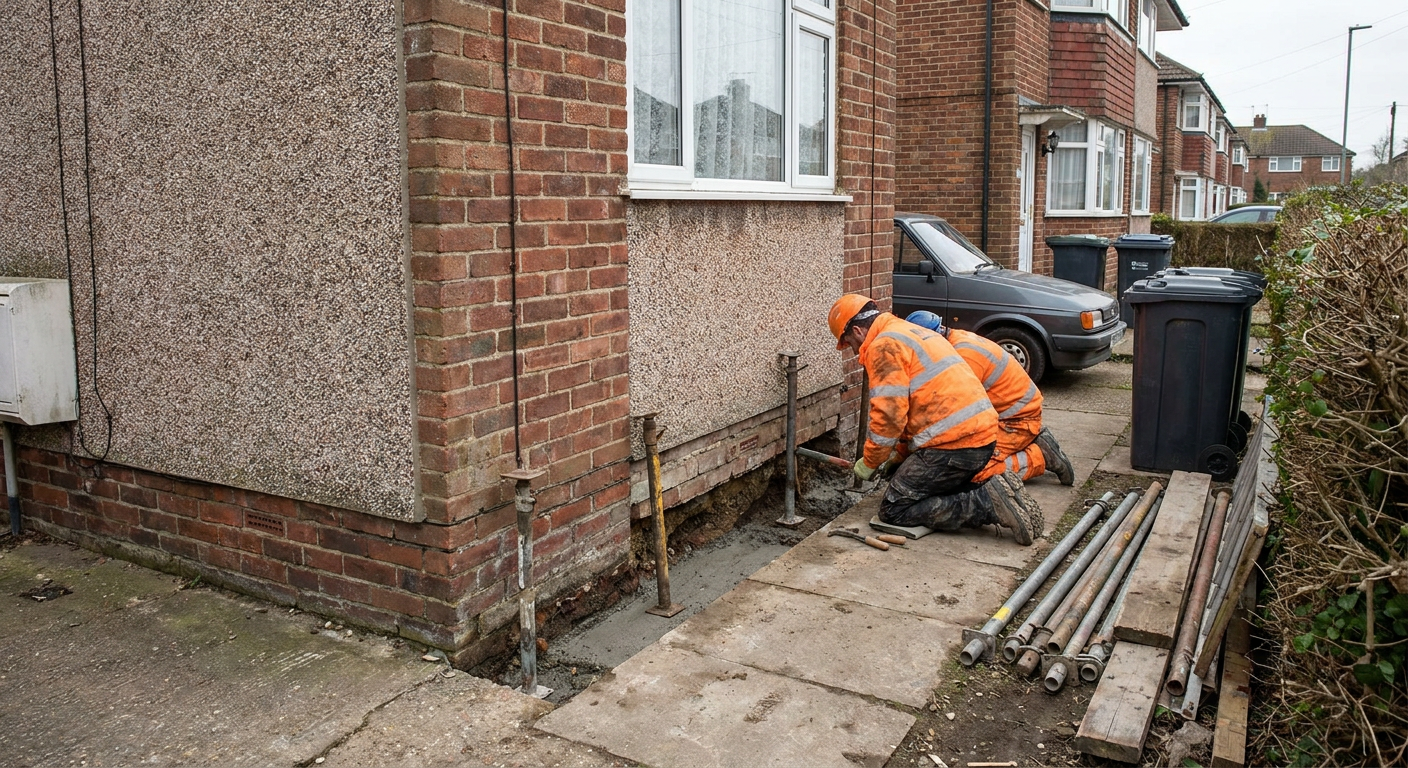
- Thin line above a window frame
- Plaster drying or minor thermal movement. Monitoring over a few months shows whether it stays stable or begins to widen.
- Diagonal crack wider at the top
- One side of the wall has dropped relative to the other. A structural survey establishes whether the footing has moved.
- Stepped cracks following mortar joints
- Brickwork separating along its weakest lines due to ground movement. Measuring the width regularly tracks the rate of change.
- Front door rubbing on the frame
- Timber swelling or the opening distorting. If windows stick too, the whole wall section may have shifted out of true.
- Floor dipping near an outside wall
- Joists losing support as the masonry below settles unevenly. Checking the subfloor void reveals whether the sleeper wall has dropped.
Questions people in Huddersfield ask before getting in touch
These come up repeatedly from homeowners noticing movement for the first time.
- Which cracks are harmless?
- Hairline cracks under two millimetres that stay the same width through the seasons are usually cosmetic. Anything widening steadily needs a surveyor to determine the cause.
- When to get foundations checked?
- Call a specialist firm if cracks exceed five millimetres, if multiple cracks appear suddenly, or if doors and floors distort at the same time.
- Are cracks in walls serious?
- They are serious when they indicate ongoing ground movement. A single static crack from old settlement rarely threatens the structure of the house.
- Who gets in touch after an enquiry?
- A specialist survey firm contacts you to arrange a visit. They need your address, a description of the damage, and any photographs you have taken.
Tell us what you have noticed in your home
Send a short description of the damage and your location. A specialist firm reviews the details and contacts you to discuss the next step. This does not commit you to any work.
- No obligation to proceed
- Local specialists respond
- Your details stay private