Guide
How deep does underpinning go? Pin depths and bases
The depth of new foundations depends on the soil beneath your Huddersfield home, where existing footings sit, and how far down firmer ground begins. Find out what determines pin depth and why it varies from house to house.
Why depth matters for a subsiding home
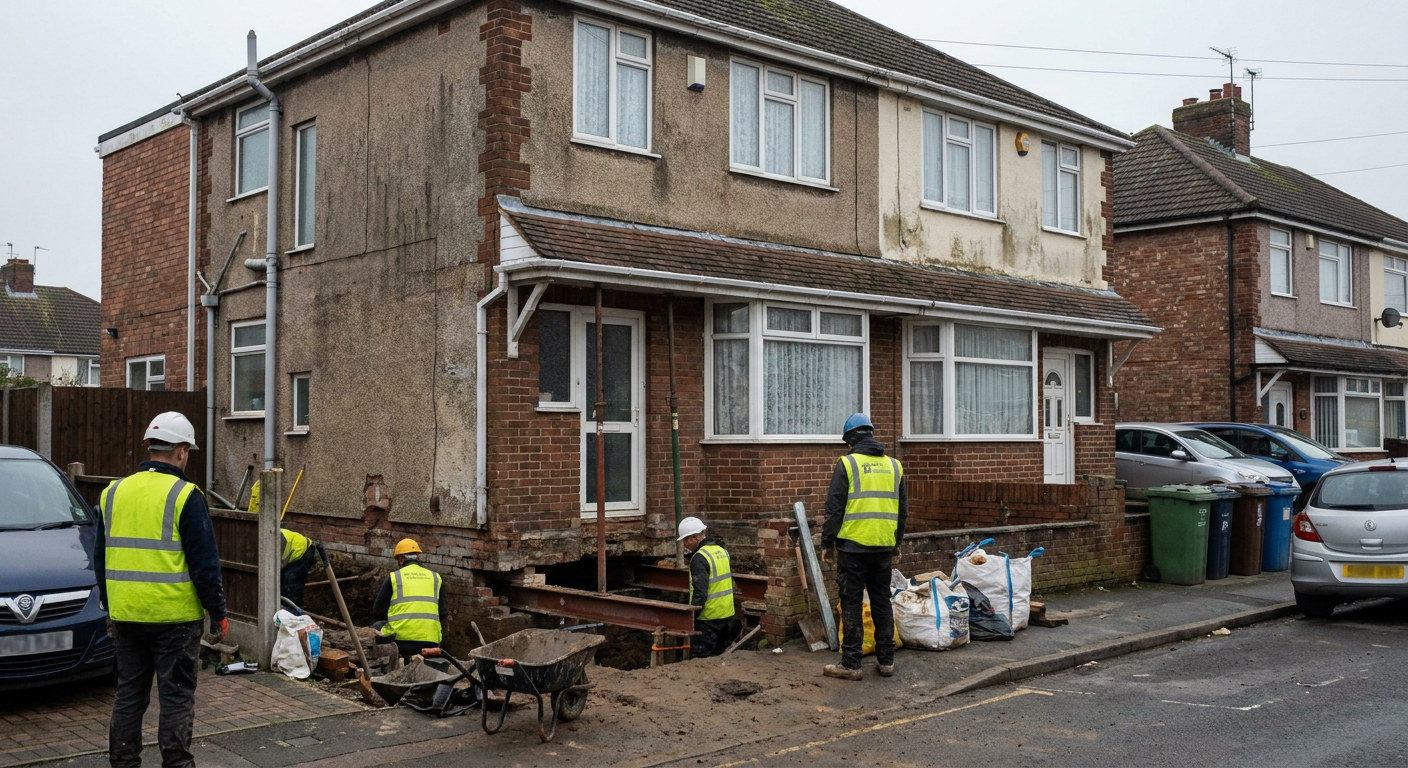
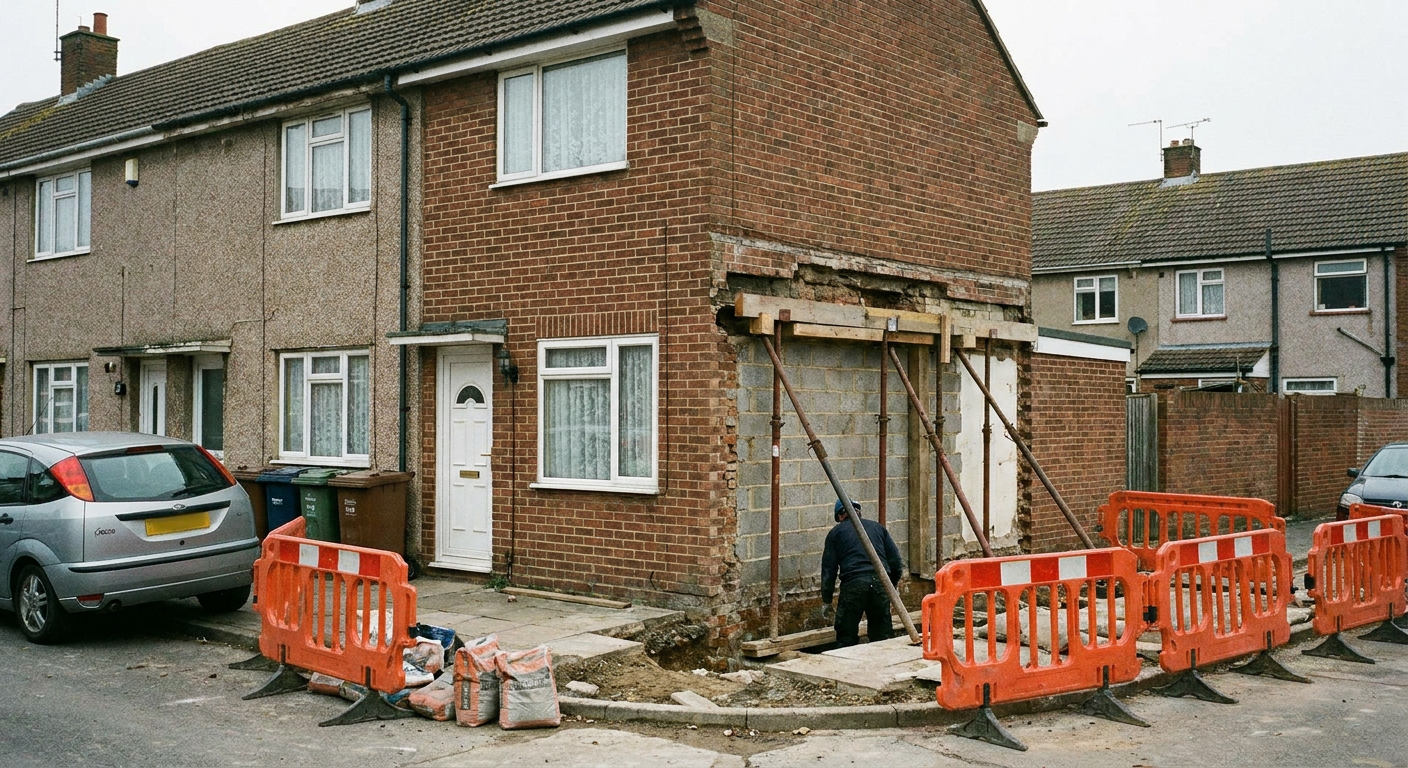
When a house sinks because the ground beneath it can no longer carry the weight, the repair must reach soil that will not move. Shallow footings fail when the earth they rest on shrinks or washes away. New concrete pins or piles have to go past that weak layer.
There is no single answer for every building. A terraced house in Brighouse might need pins taken down two metres, while a detached home near Meltham could require them at four or five. The specialist firm doing the work decides the depth after examining trial holes and soil samples. They look for the point where the ground stops compressing under load.
Going deeper than necessary costs more and takes longer. Stopping too short means the movement continues. Getting the depth right is the first job of any [subsidence survey](/subsidence-survey-huddersfield), because everything that follows depends on finding stable strata.
What lies beneath Huddersfield homes
The geology around Huddersfield changes quickly between streets. Much of the area sits on millstone grit, a hard sandstone that provides solid bearing once you reach it. But above that rock there are often thick bands of clay, glacial till, or made ground left over from older construction.
Clay is the usual cause of seasonal movement. It swells when wet and shrinks during dry spells, pulling shallow foundations with it. You can read more about the local strata in the guide to [millstone grit and clay ground](/news/millstone-grit-and-clay-ground-under-huddersfield-homes). In valleys like those around Elland and Mirfield, alluvial deposits add another soft layer before bedrock appears.
Old mining complicates things further. Where coal seams were worked close to the surface, the ground above can collapse into voids. Houses built over these workings sometimes need [specialist investigation](/what-you-can-see/old-coal-and-quarry-workings) before anyone can say how deep the new supports must go. The specialist firm drills boreholes to find intact rock below any disturbed zones.
Mass concrete pins and their typical depth
[Mass concrete underpinning](/mass-concrete-underpinning-huddersfield) is the most common method for houses in this area. The specialist contractor digs out sections of soil below the existing footing in short bays, then fills each bay with concrete to form a new, deeper foundation.
Pins usually extend between one and three metres below the original footing. The exact figure depends on where competent ground starts. If firm clay or rock is found at 1.5 metres, the pins stop there. If the soil stays soft, they go deeper.
Each bay is dug and poured in sequence so the wall above never loses support. The process suits homes with straightforward access and moderate depth requirements. For buildings where good ground lies much lower, or where space prevents open excavation, the specialist firm may recommend a different approach entirely.
Mini piling for greater depths and tight spaces
When stable soil sits beyond the practical limit of hand-dug pits, [mini piled underpinning](/mini-piled-underpinning-huddersfield) becomes the better choice. Steel-cased piles are driven or bored through weak layers until they reach rock or dense gravel, sometimes six or eight metres down.
This method works well for houses in Paddock or Honley built on steep slopes where fill material was tipped against the hillside. It also suits terraces with narrow rear yards where large excavations would risk neighbouring walls. The rig used by the specialist contractor is small enough to fit through a standard doorway or side passage.
Piles transfer the load of the house past the problem soil entirely, resting on a stratum that will not compress. Once the piles are in place, a reinforced concrete beam ties them together and supports the wall above.
Basements and lowering floors
Some homeowners want to dig out a cellar to create living space while dealing with subsidence at the same time. [Basement underpinning](/basement-underpinning-huddersfield) involves taking the existing foundations deeper in stages, forming new walls that hold back the surrounding earth.
Depths here are dictated by headroom as much as geology. To gain a usable room, the floor level might drop by two metres or more. The specialist firm has to calculate whether the ground outside can stand vertically at that new depth without collapsing inward.
Water pressure is another factor. Digging deeper often reaches the water table, so drainage and waterproofing become part of the structural design. This is heavier work than standard pinning, and building control approval is always required before the specialist contractor starts.
How the depth is decided before work begins
No reputable specialist firm guesses the depth. They start with a [structural survey](/subsidence-survey-huddersfield) and sink trial holes beside the affected walls. These holes reveal the existing footing size, the soil type at each level, and the moisture content of the clay.
If the ground is complex, boreholes follow. A drilling rig extracts continuous cores so the engineer can see exactly where soft material ends and firm strata begin. Laboratory tests measure how much the clay will shrink if the weather dries further.
Only after this evidence is gathered does the specialist contractor propose a depth and method. They might suggest [resin injection](/resin-injection-huddersfield) if the problem is shallow and confined, or full-depth piling if the weak zone extends far below the house. The decision rests on what the ground shows, not on a fixed rule.
Ask about the ground beneath your home
Send details of the movement you have noticed. The information goes to a specialist firm who can advise on what the cracks mean, with no obligation to proceed.
- No commitment required
- Local ground knowledge
- Clear next steps